How Much Does an Outstation Cab Cost in India?
Planning a trip outside your city? Before booking an outstation cab, the first question most travelers ask is, “How much will the cab cost?”
There is no single answer but a simple way to work it out. This guide will tell you exactly what you are paying for before you book. Ready to Save on Your Next Trip?
Book Your Outstation Cab
Table of Contents
Why Is Outstation Cab Pricing So Confusing?
What Factors Determine Your Outstation Cab Fare?
The Real Comparison People Need: One-Way vs Round-Trip Cab
Quick Comparison: One-Way vs Round-Trip
Popular Outstation Cab Routes & Estimated Fares (2026)
What Factors Actually Change Your Fare?
Typical Per-Km Rates by Vehicle (2026)
Aggregator App or Local Cab Operator: Which Should You Book With?
Pros and Cons of One-way and Round-trip Cab
When Should You Choose Which Option?
Money-Saving Tips
Common Mistakes People Make
Conclusion
Frequently Asked Questions
Why Is Outstation Cab Pricing So Confusing?
Because it is not just one number that matters. It is five or six small charges added together that make the difference.
Most people see a quote and assume it is the final price. Then tolls, driver allowance, or extra kilometres shows up later and the bill comes higher than expected.
The solution is simple—understand how your outstation cab fare is calculated before you book, so you can avoid hidden charges and make an informed decision. Once you know the parts it will make complete sense.
How Is an Outstation Cab Fare Calculated?
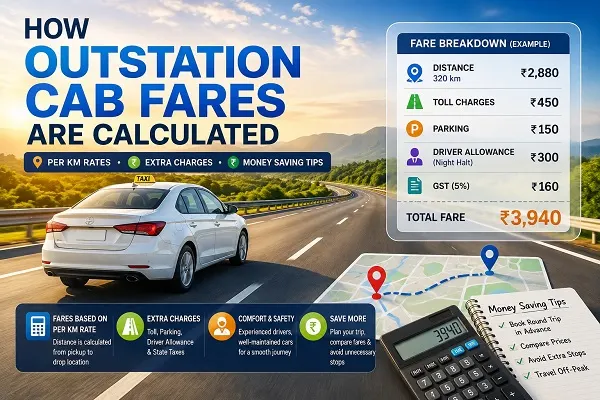
Whether you book a compact sedan or a spacious Tempo Traveller, every outstation cab fare is calculated using the same basic pricing factors. Once you know each one no quote will surprise you.
Per-km rate: The price per kilometre based on car type.
Minimum Daily Mileage: Most cab operators charge a minimum of 250–300 km per day, even if your actual travel distance is shorter.
Driver allowance: A daily fee for the driver's food and stay usually ₹300-₹400 per day.
Toll Charges: Toll fees are generally charged at actual cost and may range from ₹500 to ₹2,000, depending on the route, highway conditions, and number of toll plazas.
State entry tax or permit: ₹200-₹500 per state for commercial vehicles.
Parking charges: paid at the actuals wherever charged.
Add these together and you get your final fare. No hidden surprises once you know this list.
The Real Comparison People Need: One-Way vs Round-Trip Cab
This is where most of the confusion happens. Before comparing anything understand what each option actually means.
One-way cab:
You go from City A to City B and the cab drops you and returns empty.
Round-trip cab:
You go from City A to City B and come back with the same cab waiting for you.
The Catch
One-Way Trip Charges: Many operators price one-way trips close to round-trip fares because the vehicle may need to return empty, adding extra fuel, time, and operational costs. This is normal industry practice, not a scam but you should know it before you book.
Option A: One-Way Outstation Cab
You pay for a single drop but you are often billed for the return distance too.
Explanation: Since the driver may need to return after dropping the passenger, many operators calculate fares based on nearly double the travel distance and may also include a one-day driver allowance.
Example: Ridhima books an outstation cab from Delhi to Jaipur, covering an approximate distance of 280 km.The operator bills for 560 km at ₹10 per km which is about ₹5,600 plus tolls and driver allowance. She is not returning but she still pays for the driver's dead mileage back to Delhi.
Option B: Round-Trip Outstation Cab
You pay for the complete round journey, but the same cab remains available with you throughout your entire trip.
Explanation: The per-km rate stays the same but now you are actually using both legs of the journey so you get more value for the same total spend.
Example: Arjun and his family travel from Mumbai to Pune and back over a weekend a total of 300 km. They pay the per-km rate for the full 300 km plus ₹400 per day driver allowance for two days as the driver waits and stays with them.
Quick Comparison: One-Way vs Round-Trip
| FACTOR |
ONE-WAY CAB |
ROUND-TRIP CAB |
| You pay for |
Often double the actual distance |
Full actual distance, both legs |
| Best for |
A single drop, no return needed |
Trips with a fixed return date |
| Driver allowance |
Usually 1 day |
1 day for every night stayed |
| Value for money |
Lower, if you only need a drop |
Higher, since both legs are used |
| Typical sedan rate |
₹10–₹17 per km |
₹10–₹17 per km, same rate |
Real Examples From Popular Routes (2026 Indicative Rates)
Numbers make more sense with real routes attached to them. Here is how outstation fares is across popular cities in Indian journeys.
| ROUTE |
DISTANCE |
VEHICLE |
APPROX. FARE RANGE |
| Delhi to Jaipur (one-way) |
280 km |
Sedan |
₹4,500 – ₹6,500 |
| Mumbai to Pune (round trip, same day) |
300 km |
Sedan |
₹3,650 – ₹4,800 |
| Bengaluru to Mysore (round trip) |
300 km |
SUV |
₹5,500 – ₹7,500 |
| Delhi to Manali (one-way, overnight) |
540 km |
Innova |
₹12,000 – ₹16,000 |
| Pune to Mahabaleshwar (round trip) |
240 km |
Sedan |
₹4,000 – ₹5,500 |
These are just 2026 estimates. Always confirm the final cab quote with your operator before booking, as factors like route changes, toll charges, and fuel price fluctuations can affect the total fare.
What Factors Actually Change Your Fare?
A few things swing the price up or down more than anything else. Understanding these factors helps you estimate your cab fare before requesting a final quote.
Vehicle type: Hatchback and sedan cost less than SUV or Innova.
Season: Hill stations and holiday routes cost more during peak season.
Number of days: More overnight stays mean more driver allowance days.
Route: Toll-heavy expressways add more cost than smaller highway routes.
Booking method: Aggregator apps and direct local operators can differ by 15–30 percent.
Typical Per-Km Rates by Vehicle (2026)
| VEHICLE TYPE |
PER-KM RATE (OUTSTATION) |
BEST FOR |
| Hatchback |
₹9 – ₹12 |
Solo or 2 travellers, tight budget |
| Sedan |
₹10 – ₹17 |
Small families, 3–4 people |
| Ertiga or similar MUV |
₹13 – ₹16 |
Small groups, more luggage |
| Innova or Innova Crysta |
₹18 – ₹22 |
Larger families, comfort trips |
| Tempo Traveller |
₹26 – ₹32 |
Group trips, 8 or more people |
Aggregator App or Local Cab Operator: Which Should You Book With?
This is the second big decision after one-way versus round-trip and it changes both price and experience.
Booking app connects you to a random available driver through a mobile app. A local cab operator is a company you call or message directly which assigns you a specific car and driver.
When a Cab Booking App is good
You want instant booking without calling anyone
You prefer digital payment and live GPS tracking in one app.
Your trip is short notice, and you need a car within the hour
When a Local Operator Works Well
Always request a written, itemised fare quote before confirming your outstation cab booking.
You are booking a multi-day trip and want a dedicated, known driver.
You want to negotiate the fare or ask for a fixed, all-inclusive price.
Booking directly with a local cab operator can often save you 15–30% compared to aggregator apps, as there are usually no platform commission charges included in the fare In exchange, you may need to call or message ahead instead of booking instantly.
Pros and Cons of One-way and Round-trip Cab
Pros of One-Way Booking
Cheaper overall if you are not returning the same way
Ideal for one-time drops, like an airport-to-city transfer.
There’s no need to plan or commit to a fixed return schedule.
Cons of One-Way Booking
You may also pay for the cab's empty return journey, depending on the operator's pricing policy.
Fewer discounts are usually offered compared to round trips.
May offer limited value for trips with multiple stops along the route.
Pros of Round-Trip Booking
Better value for every kilometre you actually use.
The same driver and vehicle remain with you throughout the trip, providing greater convenience and peace of mind.
Easier to plan for multi-day holidays and family visits.
Cons of Round-Trip Booking
Higher total bill upfront, even though it offers better value.
Driver allowance is charged for every night, even rest days.
Less flexible if your return date is not yet confirmed.
When Should You Choose Which Option?
It really just comes down to your actual travel plans:-
You'd pick one-way if you're just going from A to B, like a quick work trip from Delhi to Jaipur or maybe you're dropping someone off.
A round-trip cab is an ideal choice for short vacations, weekend getaways, and business trips. Think Mumbai to Lonavala for a couple of days.
Local operators usually offer a fixed fare, making it easier to plan your travel budget. You won't get charged extra, even when it's busy.
An aggregator app? Book your cab quickly, pay online with ease, and track your ride in real time.
Money-Saving Tips
A detailed quote should clearly mention the per-kilometer rate, toll charges, driver allowance, and any applicable daily driver or vehicle charges.
See if one-way travel would save money when you plan to return back within a day or two.
It will cost about 15-30% more to book through the apps. The local travel guy directly cut much more price than apps.
If you are travelling with 4 people or fewer, go for sedan instead of SUV in terms of cost.
Visit hill stations when it is not peak season. Prices shoot up during festival season, weekends.
You ask while booking if tolls are charged or not. Not asking means you would be charged for it even if it was extra cost. Driver charges should also be clarified whether it is charged on a daily basis or per night based way.
Common Mistakes People Make
Cheapest rate: If rate is very cheap, your car will not be in good condition or they can have hidden charges. Costlier rate, which covers, shows individual cost components correctly, will be better.
Minimum kilometres policy: If you take a trip of 150 kms on car, you will be shown 300 kms as travel and they could claim the minimum kms, which you need to check first.
Ignoring toll charges and other state taxes: These are hardly ever included and you would be charged for these separately. So if two operators quotes seem different by quite a sum, you need to add the toll charges etc, after that see the difference.
Last-Minute Bookings in Hill Stations: Cab fares often increase during weekends, long holidays, and peak tourist seasons. Booking in advance can help you secure better prices.
Driver allowance charge: Sometimes this is paid separately, on day to day or night by night basis. This small but important factor can have a significant impact on your total cab fare.
Conclusion
Outstation cab pricing is easier to understand than most people think. All it takes is understanding the costs involved like: minimum km, rate per km, driver allowance, toll and any additional local/state taxes.
The ultimate choice between one-way and two-way or even local taxi operator and app-based operators is about aligning the best. The best of both the price like what the actual scenario of the trip demands.
Understand where you are going, demand a detailed quote and choose accordingly.
Install app and Get Free Fare Estimate
Frequently Asked Questions